Editorial Analysis
Analyze word usage patterns in your writing with N-gram analysis
Full N-gram Analysis
Analyze your text through unigrams, bigrams, and trigrams to understand word usage patterns and improve your writing style.
Visual Insights
Get clear visual representations of your word usage patterns through interactive charts and graphs.
Writing Improvement
Identify overused words and phrases to diversify your vocabulary and strengthen your writing.
Character Dialogue Analysis
Coming soon: Advanced analysis of character-specific dialogue patterns and speech uniqueness.
Ensure each character has a distinct voice that is uniquely their own.
Making the Most of Your N-gram Analysis
I've put together some cool insights from a deep dive into the text of your book. This analysis looks at how often you use certain words and phrases, breaking them down into single words (unigrams), pairs (bigrams), and trios (trigrams).
1. Spotting Overused Words and Phrases
The n-gram analysis shows you which words and phrases pop up the most in your book. This can help you catch any "crutch" words or phrases you might be leaning on too much.
2. Boosting Vocabulary Variety
Seeing your most-used words and phrases can give you ideas for diversifying your language. Think about using synonyms or rephrasing common expressions.
3. Strengthening Your Themes
The frequent words and phrases can also reflect the main themes and motifs in your book. Check if your themes are coming through clearly.
4. Fine-Tuning Your Writing
Use the n-gram results during editing to spot overused phrases or filler words. Cutting down on these can make your writing tighter and more impactful.
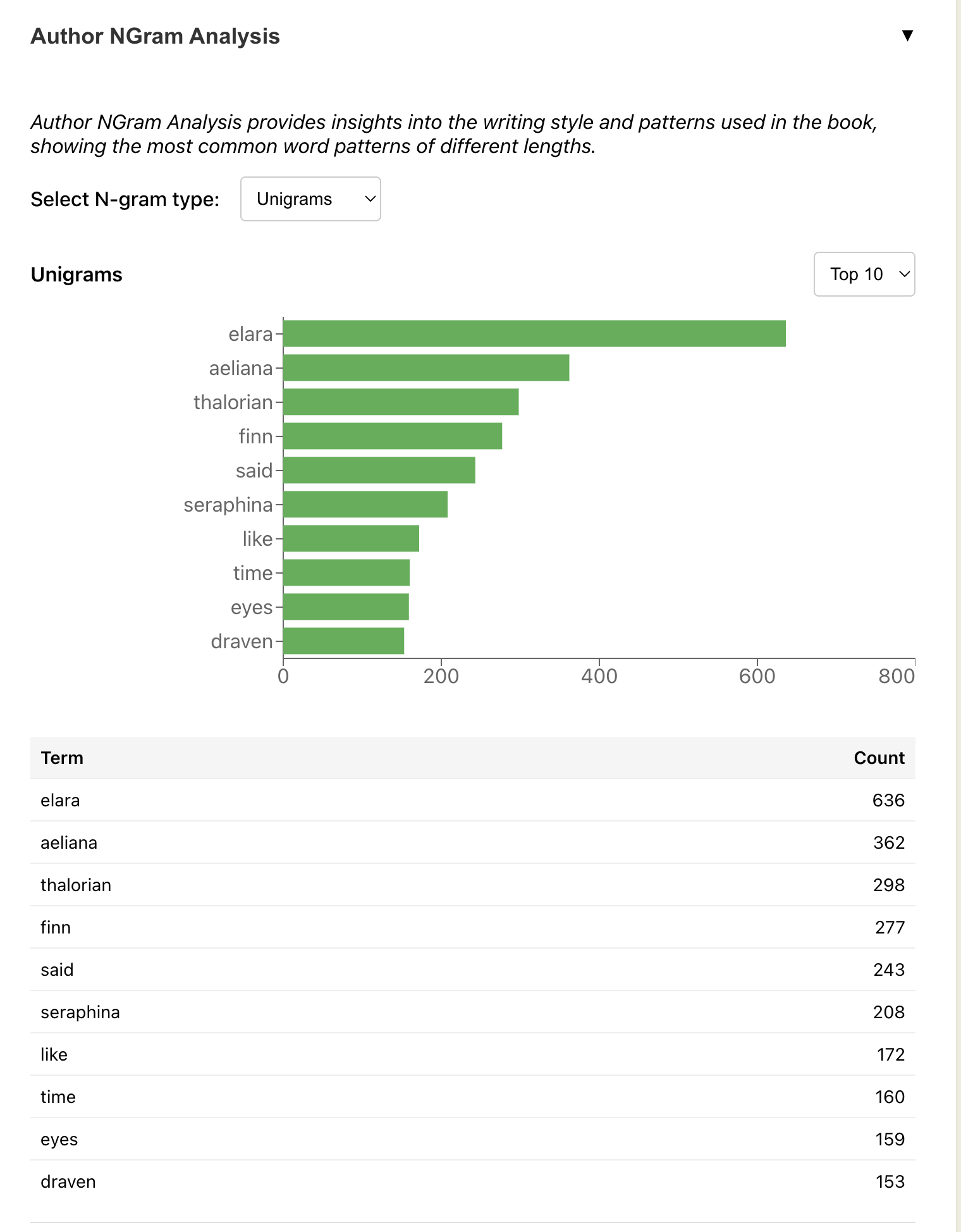
Example of unigram analysis on Woven, an unreleased novel from the Infernal Moose Publishing team.
The story primarily is about Elara, so we see her prominence in this kind of analysis.